

The Founder's Odyssey · 15 years in software · 4 months in Figma · 753 GitHub PRs
How 10,479 Chess Games Turned Into
the Coach I Always Wished I Had.
Dear fellow chess player,
Ground Zero: A Game Ends, and the Question Remains
If you play online chess obsessively, you know this exact moment.
A tough game just ended. You lost. You click “Analysis” to see what went wrong. Within half a second, the evaluation bar plunges from +0.4 to -3.2 and spits out a string of cold computer coordinates. You stare at the board, realize you still haven't genuinely understood why your human plan failed, click “New Game,” and walk into the exact same mistake ten minutes later.
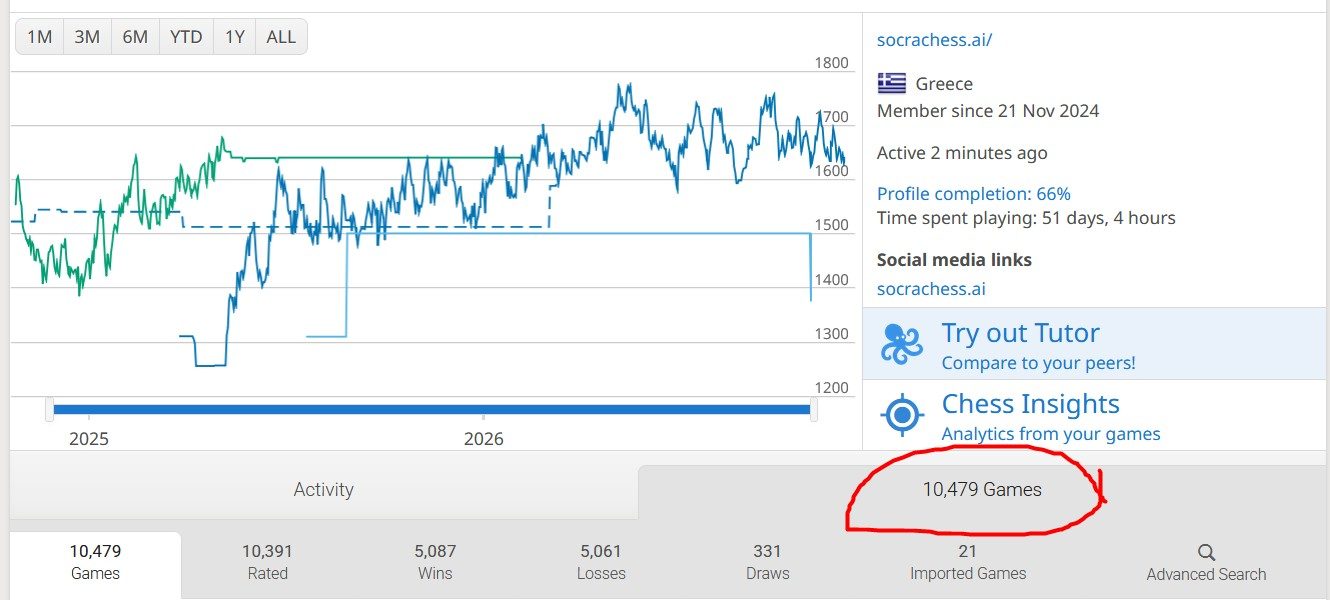
I lived that frustration across 10,479 games on Lichess (as of the moment I am writing this, and still counting).
And just so there is zero misunderstanding: I absolutely love Lichess ❤️! That is the exact reason I have played over 10,000 games there, and why I will keep playing my games there every day. Lichess and Chess.com are extraordinary places to play chess. We never built SocraChess to replace Lichess; we built it to complement Lichess for what happens after the game finishes.
All I wanted was something deceptively simple: to finally understand a chess game analysis. To sit down after a match, see where my thinking went off the rails, and actually learn from my own mistakes.
When I talked with friends and fellow chess players, I realized immediately that I wasn't alone. Every single one of them had the exact same problem: they wanted a way to learn chess through the games they were playing themselves. Out of that shared, genuine need, the idea was born.
Planting the Seed: Exhaustive Market Research Before a Single Line of Code
With a degree in Computer Science, an MBA in Business Administration, and roughly 15 years of professional experience building websites and software applications, I had the foundation to look at the problem from both sides: what the product needed to achieve pedagogically, and how it had to be engineered from the ground up.
My first step was not opening a code editor. It was researching the market inside out.
I asked myself a simple question: Before you build anything, is there already a tool out there that satisfies you as a chess player? I tested every chess analysis product I could find, both traditional tools and the new wave of AI apps. None of them solved the problem. Traditional engines gave you unplayable computer lines; AI wrappers simply handed you a pre-packaged paragraph that left your brain passive and evaporated five minutes later.
Right then and there, the seed for SocraChess was planted.
From Hand-Drawn Sketches to the “Never-Ending” World of Figma
We started with the raw basics: pen and paper. Hand-drawn wireframes, rough mockups in simple sketching tools, and a comprehensive specification document mapping out every requirement.
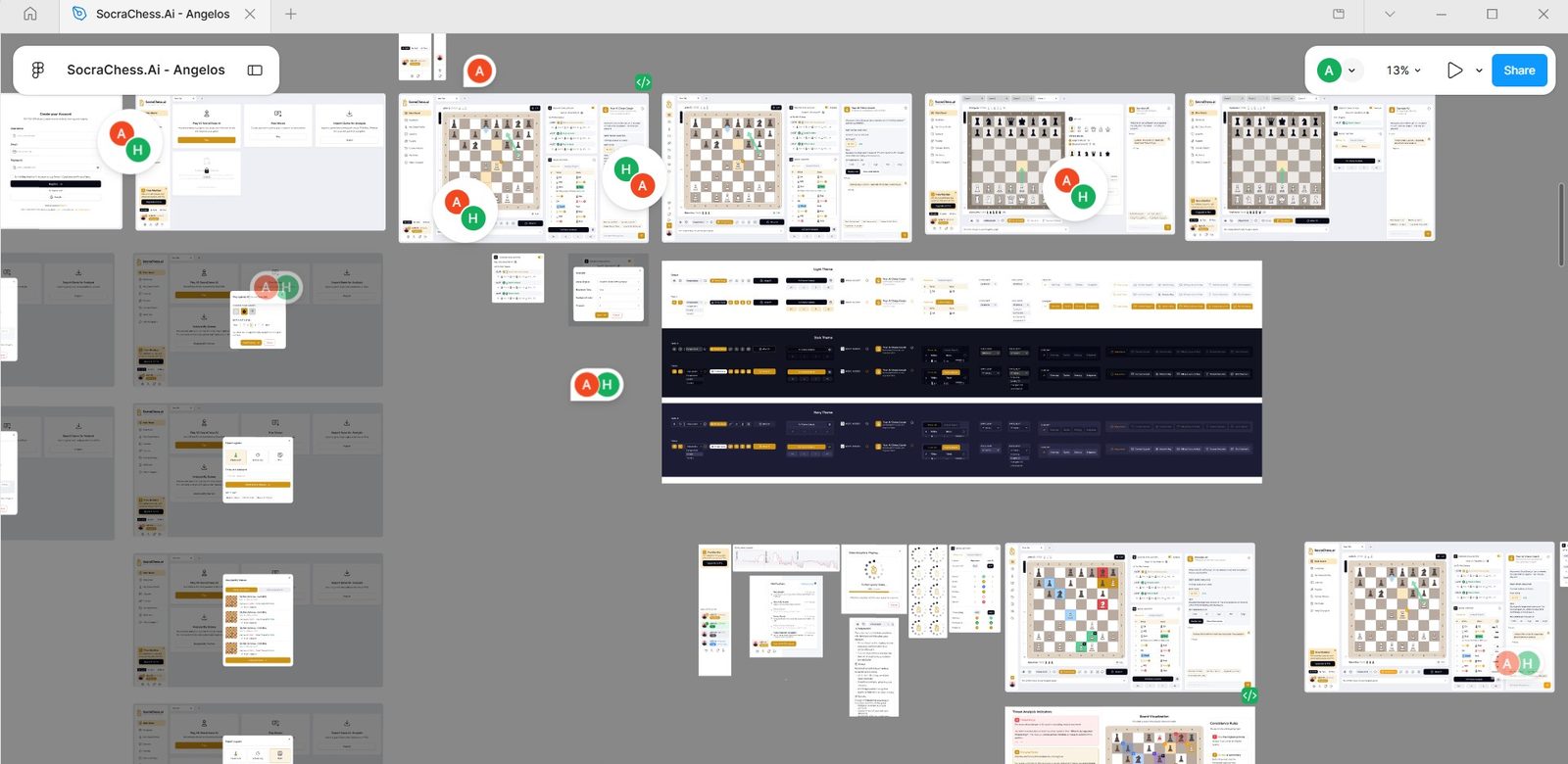
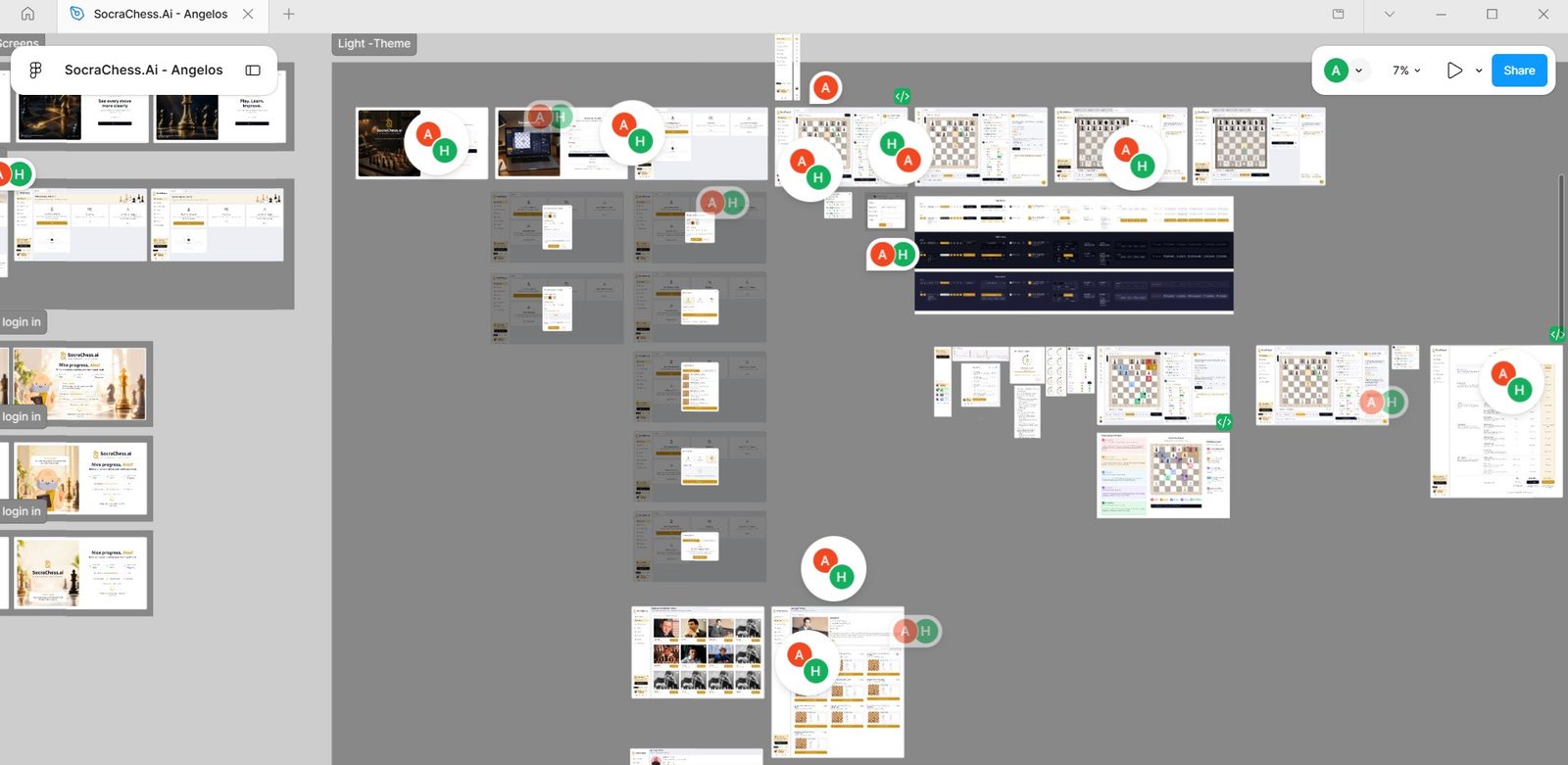
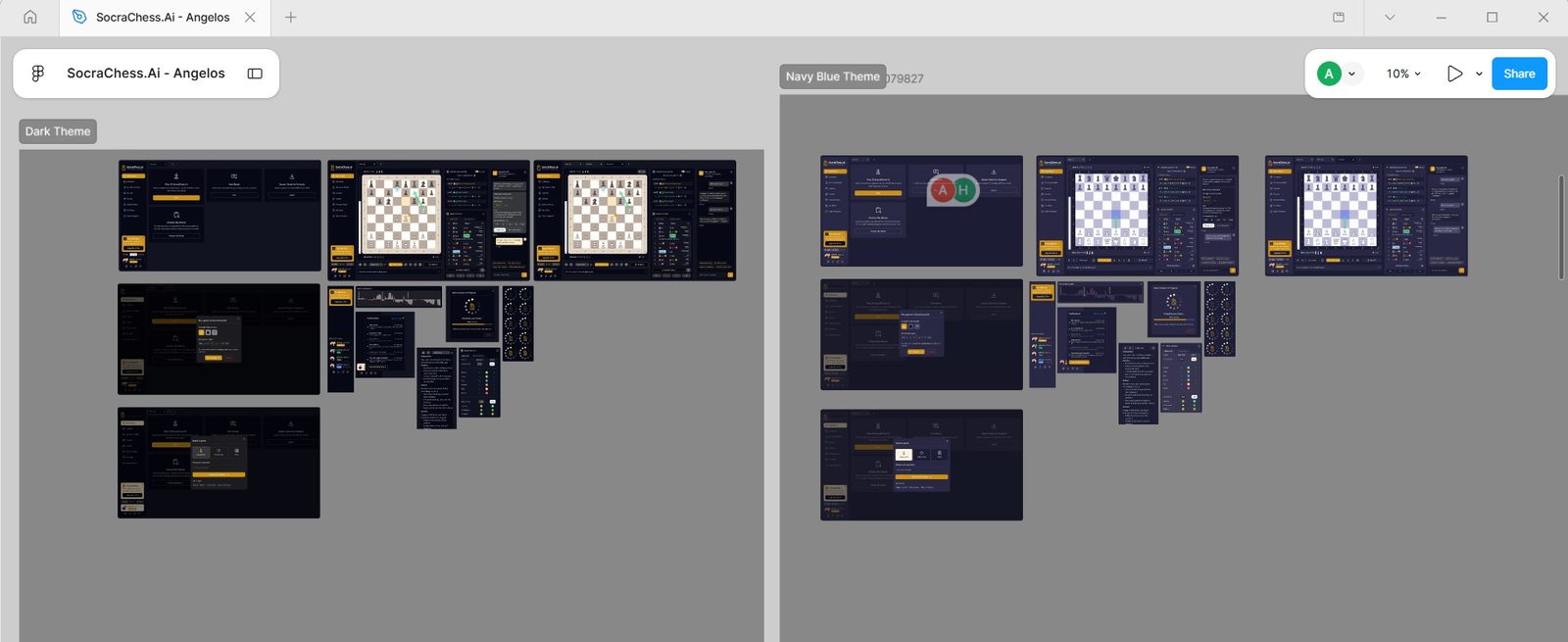
Those two tracks moved in a relentless back-and-forth loop: specs became screens, those screens exposed gaps in the user flow, and we went right back to rewrite the specs. Once the initial wireframes stood on their feet, I made the call to move into Figma.
That kicked off a 4-month design marathon that, quite honestly, I sometimes thought would never end!
I sat inside the design team myself, working daily with our UI/UX designers. Together we mapped out every conceivable screen, every popup, every menu, and every submenu, and every small decision, along with many of the changes, was mine. Painstaking as it was, that process gave us a massive advantage: we put our entire mental model onto the screen and saw the finished product before a single line of production code was ever written.
We wanted every detail to feel authentic to our own taste. Something new always popped up, something didn't sit right visually, or I would spot a fresh design idea and insist we bring it in. We still laugh about how many times we redesigned the buttons, labels, tabs, and spacing before finally declaring the designs “finished.”
Finished in Figma, that is, because as we were about to learn, those weren't the final versions either!
7 Months, 753 GitHub Pull Requests, and 2:00 AM Breakthroughs
The Figma files became our first compass. A small group of developers turned those designs into React: a live mockup you could click through, with every screen in place and no chess brain behind it yet.
From there I carried on alone, side by side with a whole crew of AI agents. Together we built the real beast: every feature, every board mode, and every analytical workflow in full detail.
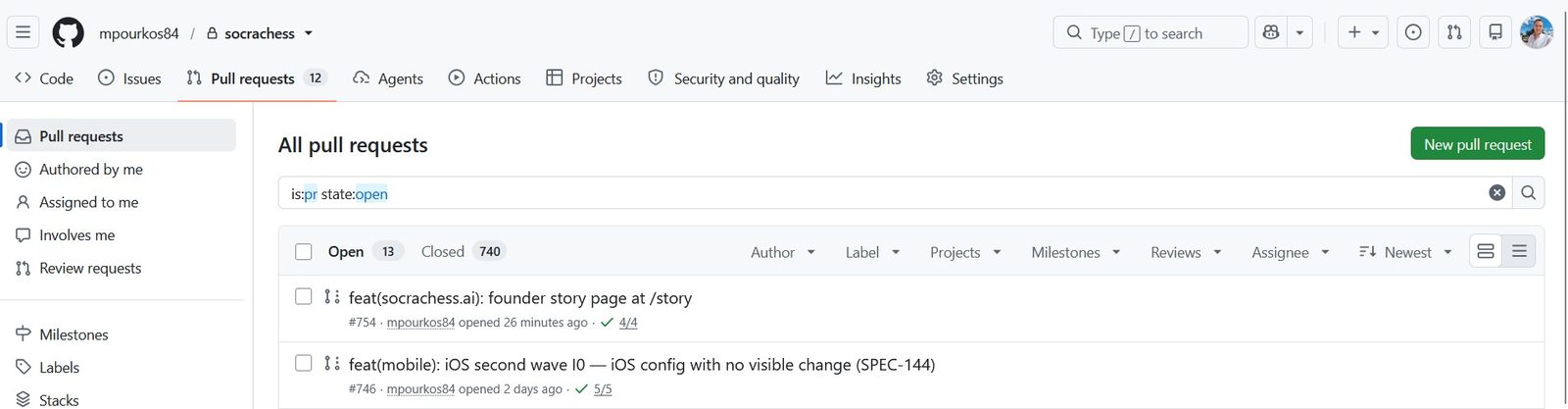
What followed was 7 full months of nonstop engineering and 753 Pull Requests on GitHub (as of the moment I am writing this!). (For my fellow chess players: a Pull Request is one packaged change to the code, proposed, tested and reviewed before it can go into the product. Think of it as a move you analyze before you play it.) It was a marathon of functionality and visual polish inside a never-ending loop: PR -> Deploy -> Check -> Feedback -> Repeat.
I vividly remember sitting at my desk at 2:00 AM because we had to push forward and the exact solution to a stubborn architectural problem had just clicked in my head. We had to marry deterministic Stockfish calculation with Socrates' pedagogical coaching, connect complex Web and mobile systems, and even upgrade core technologies mid-journey because seven months is long enough for the tech stack underneath you to evolve.
And because a real company is never just code, alongside that technical Odyssey I was juggling payment systems, accounting, corporate paperwork, trademark registrations, and legal compliance.
My Answer to the “Build an App in 24 Hours with One Prompt” Gurus
I am sharing all of this as a candid answer to the random YouTube gurus promising: “Build an app in 24 hours and get rich!” or “Create your app with a single prompt!”
With the explosion of AI, we are watching the market flood with those exact apps. Apps with no character, no soul, solving no real problem, because they really were thrown together in 24 hours with two prompts. And here is the catch: if your app was built with two prompts today, 100 identical clones will be built with two prompts tomorrow.
You can see this wave of “AI slop” in the surging number of new submissions hitting the Android and iOS app stores, and you can see its confirmation in the record wave of rejections: Apple alone turned down more than 2 million app submissions in 2025. Craftsmanship cannot be prompted into existence overnight.
And let me be clear: AI is not the villain of this story. I worked with AI agents every single day of those seven months. The villain is the belief that a prompt can replace the thinking: the research, the sketches, the months in Figma, the 2:00 AM rewrites.
What All of That Built: A Coach That Asks Before It Tells
So what came out of all those months? A chess coach that asks before it tells.
Say you import one of your own games from Lichess or Chess.com. You took the pawn on e5, and Black answered with Qg5. An engine would flash a number and a line. Socrates asks you one question: “What is the queen attacking now?” You look again, you spot the knight on e5 and the pawn on g2, and suddenly the idea is yours, not a line you skimmed and forgot.
Stockfish stays in charge of the truth on the board. Socrates turns that truth into a conversation. You choose how you want to learn: Independent, where you decide first and get feedback after the move; Guided, with candidate ideas and arrows; or Socratic, with guiding questions. Wonder what would have happened after the move you almost played? Try it in the What-If Sandbox and talk it through until it clicks.
The Starting Line: We Are Ready
After this entire app development Odyssey, I am proud to announce that SocraChess is complete.
As you read these lines, our closed Beta is live and running, and barring the unexpected, SocraChess will be officially live this month for everyone on Web and Android, with our iOS App to follow.
See you at the board,

 Founder & CEO, SocraChess.ai